PRESS & MEDIA
ReliPR & PICAR in the AI workforce story
ReliPR exists for the anxious middle of the workforce — the people who keep hearing “use AI more” without any clear way to prove they’re actually doing it well. PICAR is a 300–1000 AI-readiness score built to make that visible.
This page is for journalists, editors, podcast hosts, and analysts who need clear, quotable context on AI readiness at work.
On deadline?
Email us with your topic and timing. We’ll respond as fast as possible, usually within 24 hours.
Why PICAR exists right now
Most professionals are being told to “use AI more,” but almost nobody is being given a clear definition of what “good” looks like. That gap is where anxiety and quiet layoff fears live. PICAR exists to put a stable, 300–1000 readiness score on how people actually work with AI across real tasks.
Story hooks
From vibes to a score
AI at work is currently judged by anecdotes and self-promotion. PICAR turns “I’m good with AI” into a measurable score managers can actually react to.
The anxious middle, not the loud extremes
Most workers are neither AI doomers nor influencers. They’re just quietly worried about being left behind. ReliPR is built for that middle.
A loop, not a quiz
PICAR isn’t trivia about AI models. It measures how people prompt, review, refine, and ship work when AI is in the loop — the behavior managers actually care about.
Fast facts for coverage
Short, quotable context you can drop into briefs, newsletters, or scripts. No hype, no fluff.
What PICAR measures
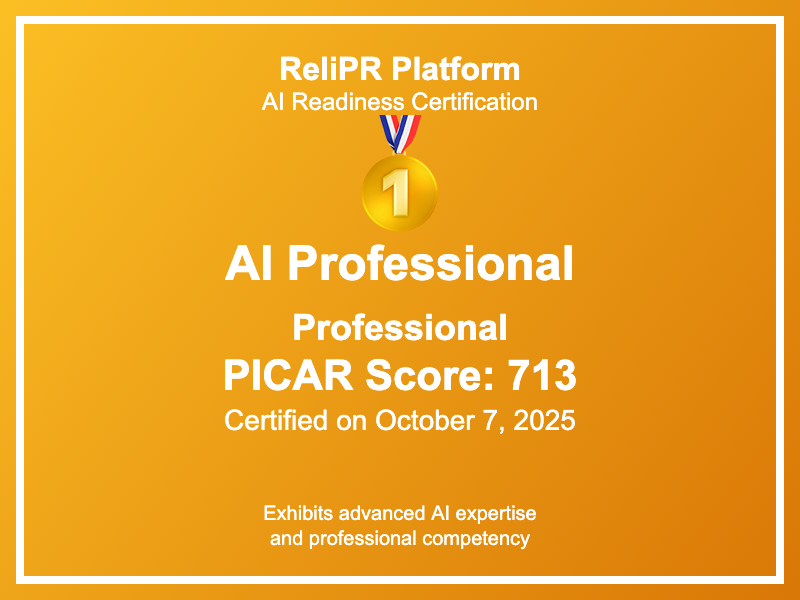
PICAR looks at five dimensions of AI readiness: Prompting, Integration, Critical Analysis, Adaptation, and Risk Management. The score lives on a 300–1000 scale.
Who it’s for
Built for individual professionals, managers, and teams in roles where AI is starting to reshape expectations: marketing, content, customer success, operations, and more.
How it works
Professionals run through real-world scenarios where AI is already in play, not theoretical quizzes. PICAR observes how they prompt, review, refine, and log what happened.
Baseline vs. verified score
Workers can start with a quick baseline estimate from their résumé or LinkedIn profile (2–3 minutes), then run the full PICAR loop (about 30 minutes) for a verified score.
Business model
The core PICAR assessment is free for individual professionals. Employers pay for team-level insights and benchmarking; personal scores stay private unless workers choose to share them.
Privacy stance
Workers keep full control of their scores and accounts. They can delete their data permanently at any time. PICAR assessment data is never sold.
Story angles we can help with
If you’re working on any of these angles, we can share anonymized patterns, frontline stories, and clear language your audience can use.
“What does it actually mean to be ‘AI-ready’ at work?”
Most people have installed AI tools. Very few can show a repeatable way they use them under pressure. PICAR turns that into something measurable.
“How AI anxiety is showing up in performance reviews”
Managers are quietly adding “AI” expectations without changing the review process. We see where that creates confusion and missed opportunities.
“Who’s really at risk in the AI reshuffle — and who’s undervalued”
Some roles look safe on paper but score low on AI readiness. Others look easy to replace but have workers quietly running strong AI loops already.
“Why watching AI tutorials isn’t the same as AI readiness”
There’s a big gap between “I’ve watched videos” and “I can steer AI outputs without hurting the brand, data, or compliance.” PICAR was built to make that gap visible.
“Should workers put ‘AI-ready’ scores on their résumés?”
We can talk about when a score helps, when it backfires, and how to share it without turning it into another vanity metric.
“What managers actually look for when AI enters the job description”
From our conversations, most managers don’t want prompt hackers — they want calm, auditable loops. We can explain that in plain language.
Quotes you can pull directly
Pre-cleared lines you can lift as-is. Attribution details are below the quotes.
“Most professionals are being told to ‘use AI more,’ but almost nobody is being told what ‘good’ actually looks like. That’s the gap PICAR is built to measure.”
“AI readiness isn’t about knowing every model. It’s about whether you can run a calm, repeatable loop: take a rough AI output, stress-test it, fix the gaps, and ship work your manager can trust.”
“A 300–1000 AI-readiness score doesn’t replace human judgment, but it finally gives anxious workers a way to say, ‘Here’s where I am. Here’s what I’m improving next.’”
“The loudest AI voices are often the least representative. PICAR is built for the quiet middle of the workforce who just want to keep their jobs, grow their skills, and avoid being blindsided.”
Attribution: Please attribute quotes to “Kiran Nat, co-founder of ReliPR and creator of the PICAR AI Readiness Framework.”
About ReliPR
ReliPR is an early-stage, privacy-first platform focused on AI readiness for working professionals. Our goal is to give workers and managers a shared, sane way to talk about AI skills — without turning it into another hype cycle.
About the PICAR framework
PICAR stands for Prove → Improve → Clarify → Amplify → Repeat. It’s a loop pulled from real workplace domains, not lab demos. The framework looks at how people work with AI under realistic constraints: messy inputs, brand risk, time pressure, and incomplete information.
Press contact
For interviews, quotes, or background, reach out directly: